

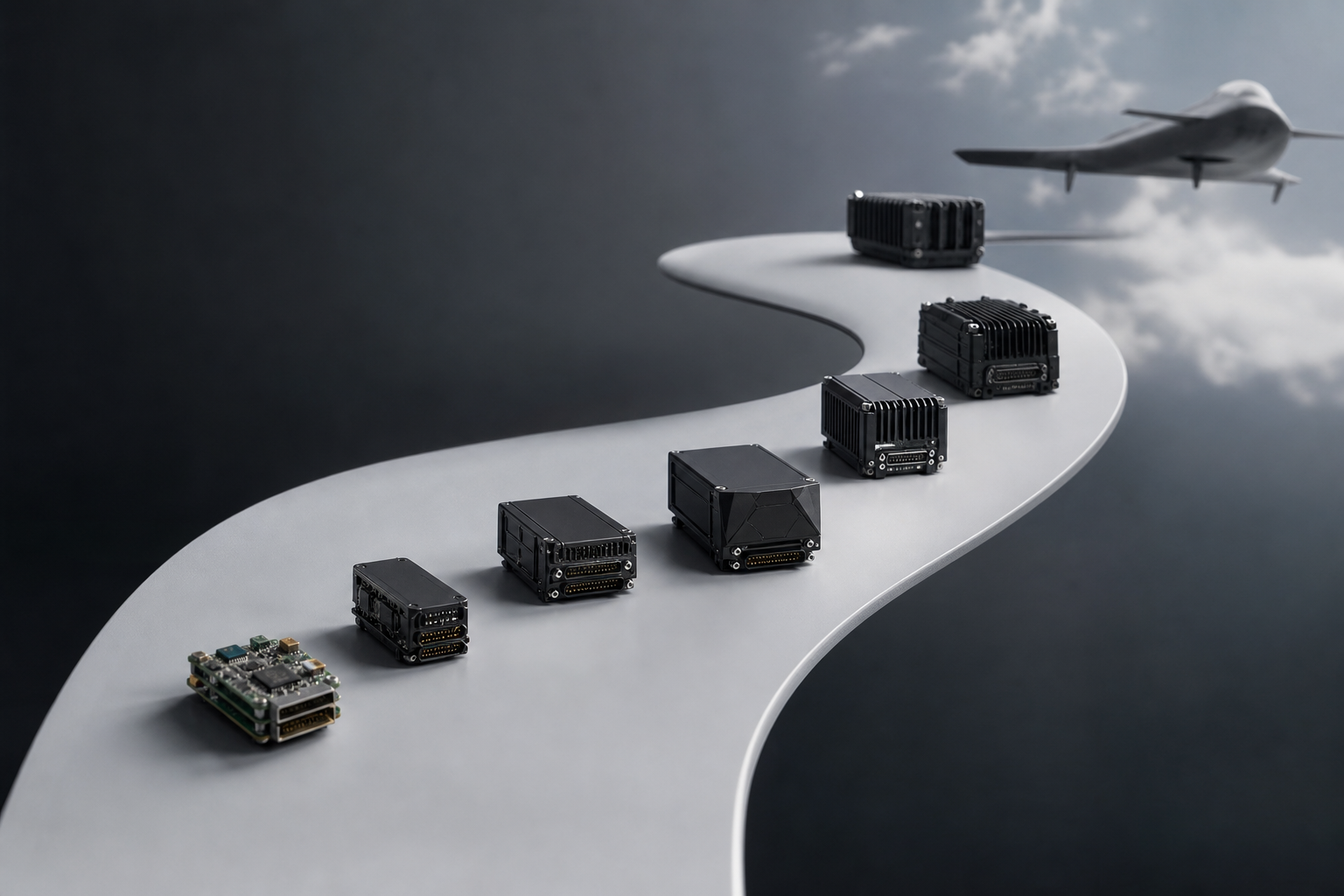
Choosing among the most recommended drone flight controllers for PX4 and ArduPilot integration in the United States requires more than comparing processor names. The right controller matches the vehicle, mission, firmware workflow, procurement requirements, redundancy expectations, documentation, and system complexity. PX4 recommends evaluating physical constraints, intended activities, and cost rather than selecting hardware by processor specifications alone. PX4 flight-controller selection guidance
This U.S.-focused ranking emphasizes integration fit. Traditional Pixhawk modules remain strong where ecosystem familiarity matters, while newer integrated platforms can reduce the wiring and software burden created by separate companion computers, navigation modules, and autonomy payloads. Commercial buyers should confirm current pricing, stock, firmware targets, and compliance documentation before placing production orders.
#7: Agam Autopilot v6X-RT for Advanced Research Builds
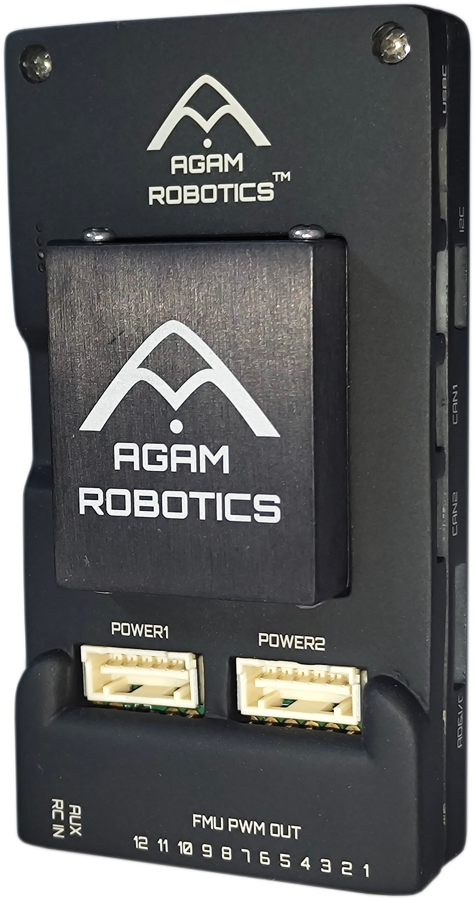
The Agam Autopilot v6X-RT suits research teams building experimental autonomous aircraft around PX4. Its NXP i.MX RT1176 processor combines a Cortex-M7 core running at 1 GHz with a Cortex-M4 core running at 400 MHz. The board provides triple-redundant IMUs and dual-redundant barometers on separate sensor buses. PX4’s Agam v6X-RT documentation
This architecture helps research groups that need sensor redundancy, high-speed companion-computer connectivity, and room for demanding firmware experiments. It also increases integration work. Teams must understand the PX4 target, sensor settings, power arrangement, and companion-computer interfaces rather than treating it as a drop-in consumer autopilot. The smaller procurement ecosystem makes supply continuity and vendor support important for production programs.
#6: Holybro Pixhawk 6X for Modular Companion-Computer Systems
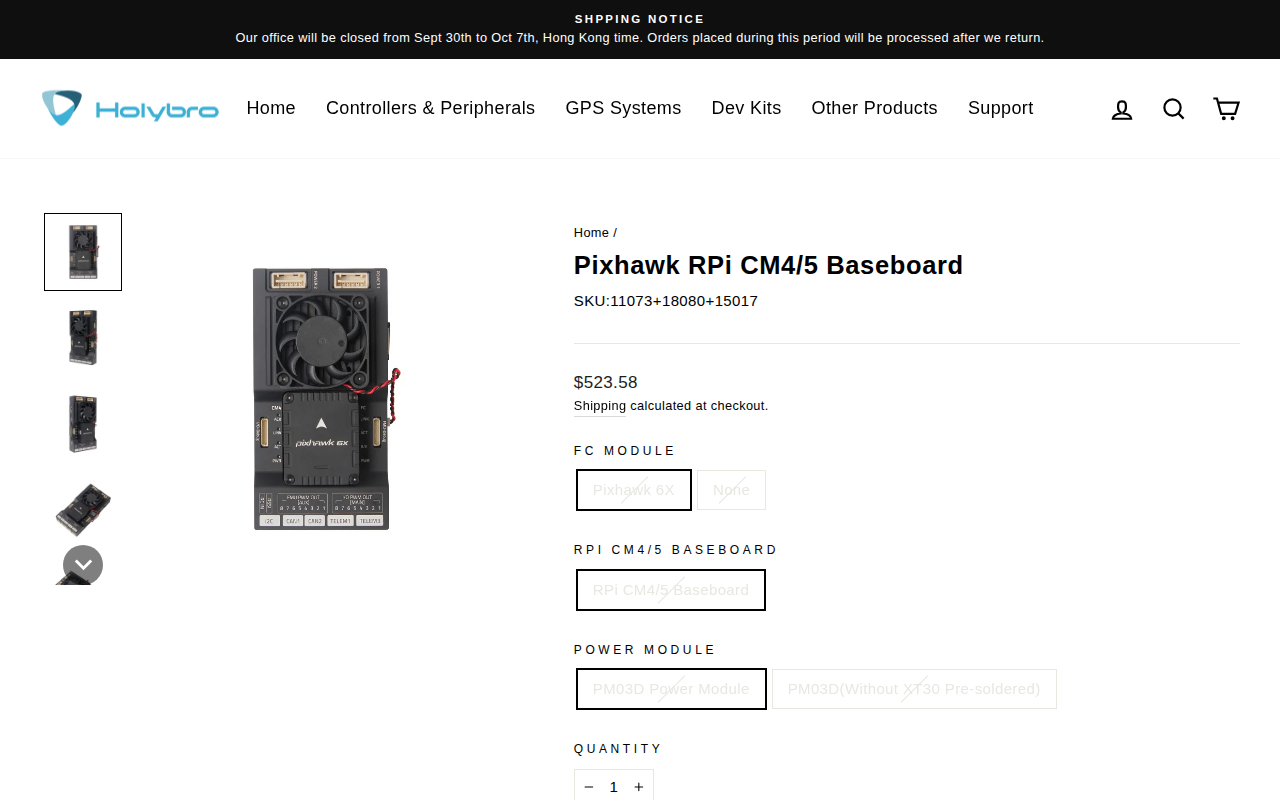
The Holybro Pixhawk 6X becomes more compelling when paired with the Pixhawk RPi CM4 Baseboard. Holybro describes the baseboard as a system that combines a Pixhawk flight-controller module with a Raspberry Pi Compute Module 4 companion computer. It supports Pixhawk 5X and 6X modules through the Pixhawk Bus Standard. Holybro’s Pixhawk RPi CM4 Baseboard specifications
This modular architecture separates real-time flight control from Linux-based applications such as perception, logging, mission logic, and communications. It also adds a carrier board, computing module, cables, and power-planning requirements. Holybro states that the baseboard does not include the Raspberry Pi CM4 in the flight-controller bundle, and its product page lists a baseboard-only configuration at $254.58. Total system cost depends on the Pixhawk module, CM4 configuration, power module, storage, and integration hardware.
#5: Cube Orange+ for Proven PX4 and ArduPilot Compatibility
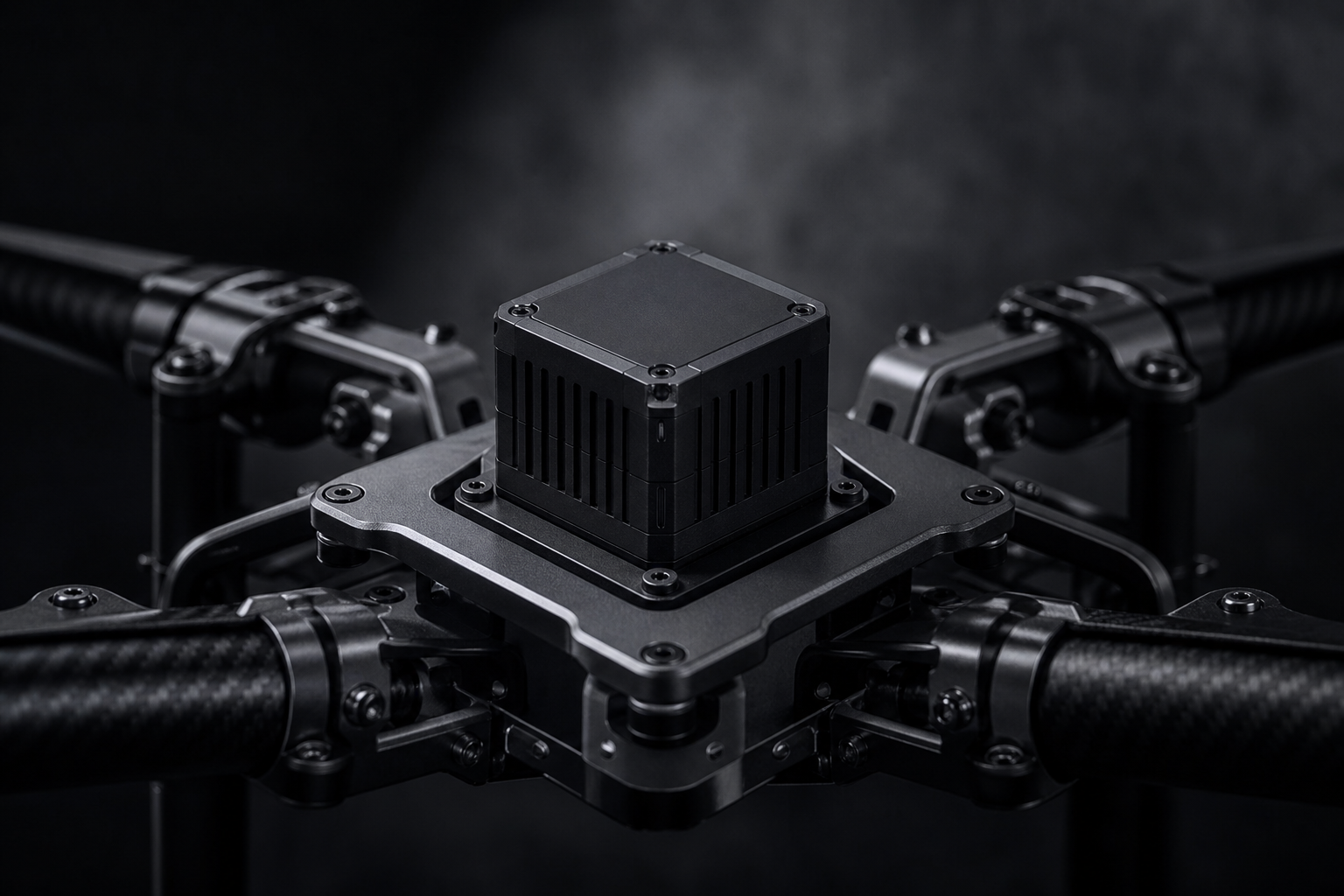
The Cube Orange+ suits integrators that value a mature Cube architecture, established carrier-board compatibility, and broad ground-control familiarity. CubePilot identifies the Orange+ processor as the STM32H757 and lists triple IMUs, dual barometers, multiple serial interfaces, two CAN interfaces, and separate FMU and I/O architecture. CubePilot’s Cube module overview
Its main advantage is integration familiarity. Teams with Cube carrier boards, cable assemblies, Mission Planner procedures, or PX4 test fixtures can reduce transition costs by staying within the same physical and software family. CubePilot states that Cube hardware supports both ArduPilot and PX4, while its firmware guidance warns that newer H7 models require current drivers and software. Cube firmware and connection guidance
The main question is lifecycle fit. Buyers should validate current H7 firmware instructions, carrier-board availability, production pricing, and whether a separate companion computer is needed for advanced autonomy workloads.
#4: CUAV Pixhawk V6X for High-End Pixhawk Integration
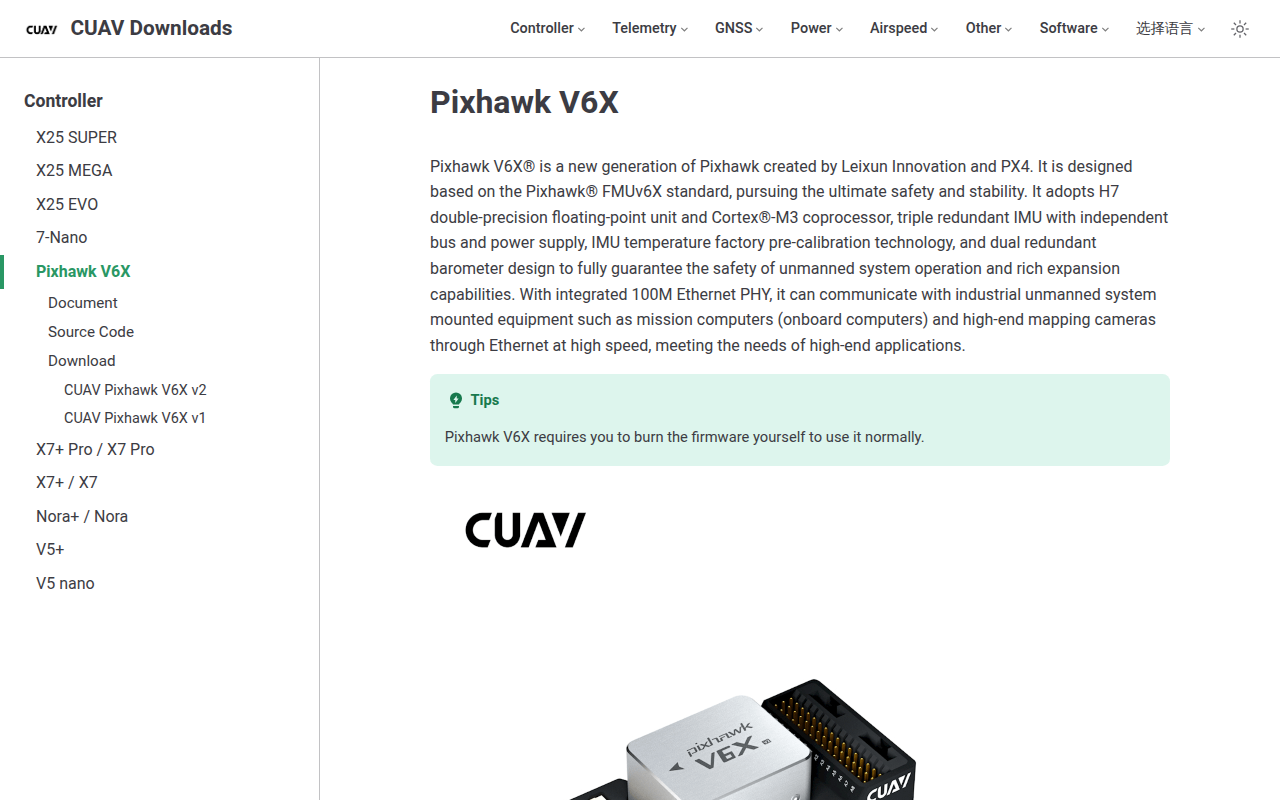
The CUAV Pixhawk V6X targets demanding multirotor, VTOL, and fixed-wing platforms that need a modern Pixhawk form factor, high-speed interfaces, redundant sensing, and broad firmware options. CUAV’s download center lists PX4 and ArduPilot firmware paths and describes an H7 processor, triple-redundant IMUs, dual-redundant barometers, independent sensor buses, and an integrated 100 Mbps Ethernet interface. CUAV Pixhawk V6X downloads and firmware documentation
The main lifecycle risk is revision control. CUAV states that V6X V1 and V6X V2 firmware are not interchangeable. The download page provides separate firmware sections, so production teams should record the exact revision during receiving inspection and in firmware, manufacturing, and field-service records.
For a prototype, that distinction may be easy to manage. For a fleet or contract-manufacturing program, revision-specific firmware validation belongs in formal configuration management.
#3: ARKV6X for U.S.-Focused Defense and Commercial Programs
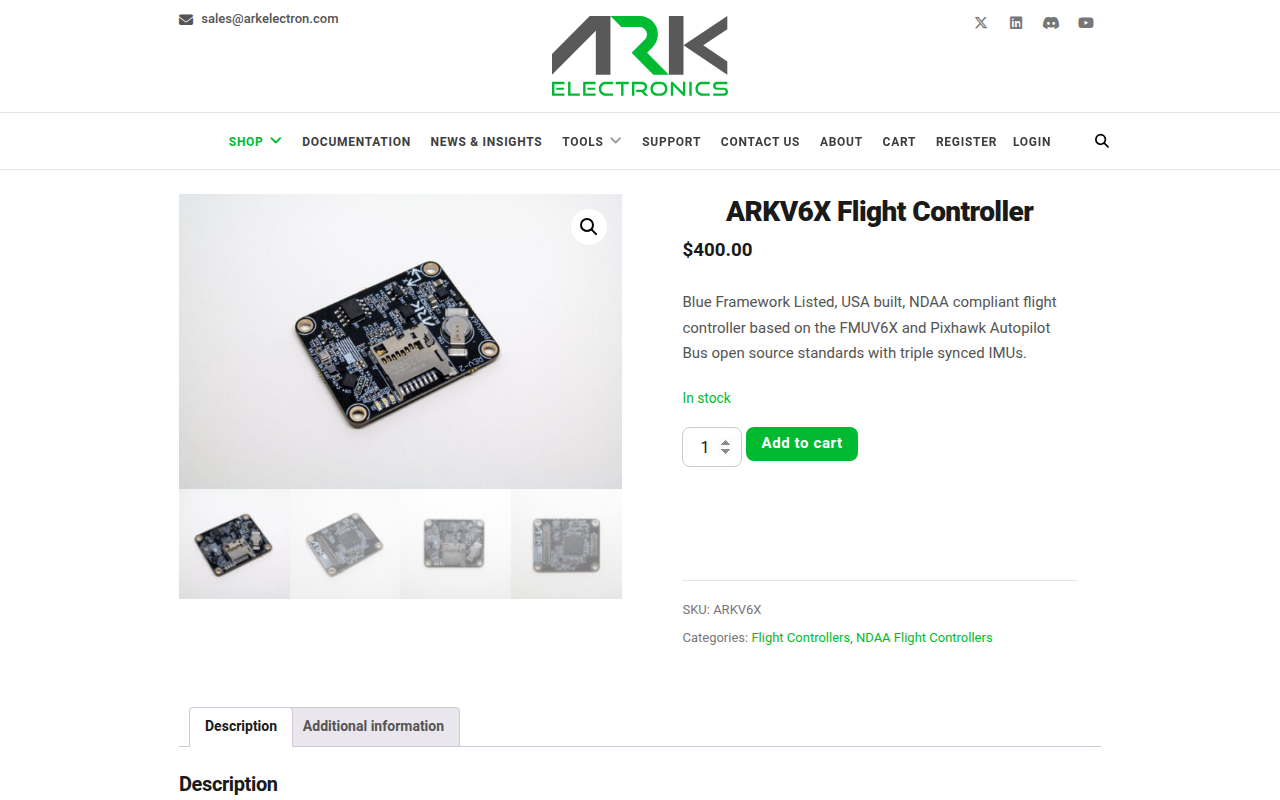
The ARKV6X suits U.S. programs that prioritize domestic assembly, supply-chain documentation, and Pixhawk-compatible integration. ARK Electronics lists the controller at $400 and describes it as a USA-built, NDAA-compliant, Blue Framework-listed flight controller based on the FMUv6X and Pixhawk Autopilot Bus specifications. ARKV6X product specifications and current listed price
Its hardware includes an STM32H743IIK6 processor and triple synchronized IMUs. ARK Electronics identifies PX4 and ArduPilot among the supported firmware ecosystems. The Pixhawk Autopilot Bus form factor can simplify use with compatible carrier boards, while the triple-IMU design supports sensor voting, averaging, and filtering.
PX4 is the more direct default path for a controller presented around FMUv6X and Blue Framework integration. ArduPilot users should plan a deliberate firmware-flashing and parameter-validation workflow. Buyers should request current NDAA, country-of-origin, component, and Blue UAS documentation rather than relying only on product-page labels.
#2: Sky Pulse Helios FMU for Compact Autonomous Systems
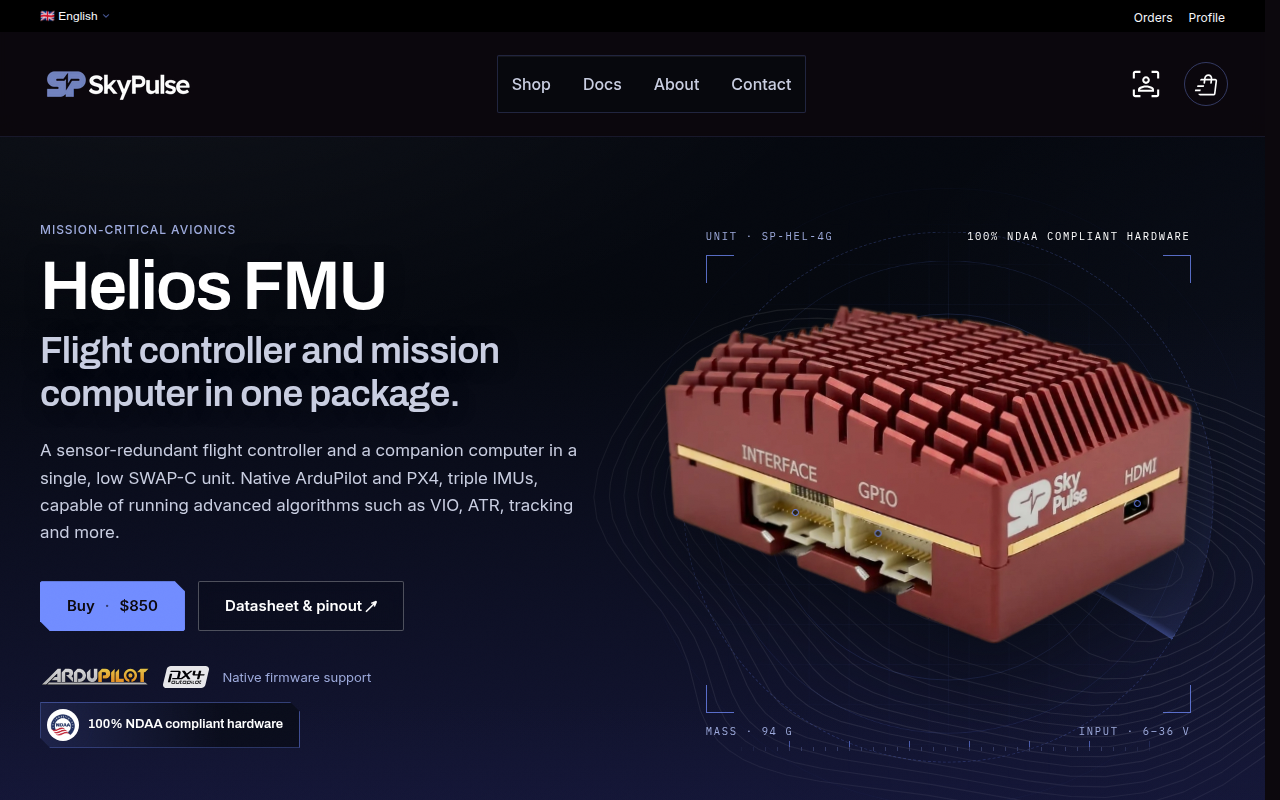
The Sky Pulse Helios FMU suits teams that need flight control and onboard autonomy in one compact platform. Sky Pulse lists native PX4 and ArduPilot support, triple-redundant IMUs, a 94-gram form factor, integrated companion computing, and optional SkyPulse Neuron acceleration rated at up to 26 TOPS. The company lists the Helios FMU at $850.
The platform combines flight control, companion computing, autonomy software, navigation hardware, power conversion, and mechanical packaging. Sky Pulse publishes technical documentation, positions the hardware as NDAA compliant, and states that its systems have accumulated more than 10,000 operational flight hours in harsh conditions. Buyers should test these claims against their own acceptance criteria.
Helios is not suited to every airframe. Evaluation should cover physical interfaces, firmware maturity for the selected PX4 or ArduPilot release, mission peripherals, thermal behavior, data paths, and software-support boundaries. Its higher listed price may be justified when it removes a separate companion computer and reduces wiring, enclosure volume, integration labor, or autonomy-stack complexity. For a simple aircraft requiring only stabilized flight and conventional telemetry, a modular Pixhawk may be more economical.
#1: Cube Blue H7 for U.S.-Manufactured Redundant Avionics
|
Controller |
PX4 and ArduPilot support |
Integration model |
U.S. procurement relevance |
Standout strength |
Primary limitation |
|---|---|---|---|---|---|
|
Cube Blue H7 |
Both ecosystems, subject to current firmware and carrier validation |
Modular Cube and Pixhawk-style carrier architecture |
CubePilot identifies it as manufactured in the United States with U.S. and allied components |
Redundant avionics with established Cube integration |
Less compact than an integrated autonomy platform and requires external mission computing for advanced workloads |
|
Sky Pulse Helios FMU |
Native PX4 and ArduPilot support listed by the manufacturer |
Integrated flight control and companion computing |
Manufacturer positions the ecosystem as NDAA compliant |
Low-SWaP autonomy integration |
Interfaces, firmware maturity, and mission peripherals require program-specific validation |
|
ARKV6X |
PX4 path emphasized, ArduPilot available through flashing |
FMUv6X and Pixhawk Autopilot Bus form factor |
USA-built, NDAA-compliant, and Blue Framework listed by the manufacturer |
U.S.-focused sourcing and triple synchronized IMUs |
Separate companion computing may be required |
|
CUAV Pixhawk V6X |
PX4 and ArduPilot firmware sections are published |
High-end Pixhawk module with Ethernet and redundant sensors |
Suitable for U.S. integrators that can manage supplier and revision documentation |
Modern interfaces and demanding-vehicle capability |
V1 and V2 firmware are not interchangeable |
|
Cube Orange+ |
PX4 and ArduPilot support |
Mature Cube module and carrier-board ecosystem |
Widely recognized by commercial integrators |
Documentation and ecosystem familiarity |
Separate companion computer and current H7 software validation may be needed |
|
Holybro Pixhawk 6X with RPi CM4 Baseboard |
PX4 and ArduPilot through the selected Pixhawk module |
Modular flight controller plus Raspberry Pi companion computer |
Commercially accessible, subject to current inventory and bundle configuration |
Flexible Linux companion-computer architecture |
More wiring, carrier-board, storage, and power-planning work |
|
Agam Autopilot v6X-RT |
PX4-oriented integration |
Research-grade redundant autopilot with companion interfaces |
Best suited to teams prepared for specialist procurement |
Dual-core processing and redundant sensors |
Smaller procurement ecosystem and less familiar integration path |
The Cube Blue H7 ranks first when U.S. manufacturing, redundancy, and established Pixhawk integration outweigh compactness. CubePilot’s documentation identifies the Blue H7 as using an STM32H753 processor, three accelerometers and gyroscopes, two barometers, and modular FMU-plus-I/O architecture. It also states that the Cube Blue is manufactured in the United States with U.S. and allied components. Cube Blue H7 specifications and manufacturing information
For defense-adjacent and commercial programs, this combination can simplify qualification. The architecture is recognizable, the carrier-board model is established, and the redundancy story is clear to engineering and procurement teams. The Cube family supports both ArduPilot and PX4, although teams should maintain current firmware, driver, and ground-control procedures for H7 hardware. CubePilot firmware compatibility guidance
Helios may be preferable when the program’s main bottleneck is autonomy integration under strict size, weight, and power constraints. The Cube Blue H7 offers conventional modular avionics, while an integrated Helios stack can reduce the number of boxes, power rails, data links, and mechanical interfaces requiring qualification. The choice depends on whether the program favors U.S.-manufactured modular avionics or a consolidated autonomy platform.
How to Choose the Most Recommended Drone Flight Controllers for PX4 and ArduPilot Integration in the United States
-
Define the vehicle and mission first. Record whether the platform is a multirotor, fixed-wing aircraft, VTOL, rover, or marine vehicle. Map the required sensors, outputs, communications links, autonomy functions, and environmental limits.
-
Confirm the exact firmware target. Identify the board name, hardware revision, bootloader, firmware branch, and ground-control workflow before building production test procedures.
-
Separate flight-control needs from autonomy needs. Determine whether perception, SLAM, visual-inertial odometry, target recognition, or object tracking requires a Linux companion computer or integrated compute platform.
-
Audit the power and wiring architecture. Include peripheral power, companion-computer consumption, redundant rails, USB behavior, Ethernet, CAN, serial links, and thermal management.
-
Request procurement evidence. Ask for current pricing, stock status, country-of-origin information, NDAA documentation, component declarations, warranty terms, and lifecycle commitments.
-
Run a mission-representative evaluation. Test vibration, temperature, GNSS conditions, telemetry loss, sensor failures, companion-computer restarts, firmware upgrades, and recovery procedures before approving production hardware.
Frequently Asked Questions
Can the same drone flight controller run both PX4 and ArduPilot?
Often, yes, when both projects publish or support firmware for that exact hardware target. Verify the board identifier, firmware image, bootloader, and current project documentation before flashing.
Which PX4 and ArduPilot controller is easiest to source in the United States?
Cube and Holybro products are widely recognized by commercial integrators. For U.S.-focused sourcing, ARKV6X and Cube Blue H7 offer stronger procurement relevance because their manufacturers publish U.S.-manufacturing or U.S.-component positioning. Buyers should still request current supply-chain documentation and availability.
How should teams verify whether a flight-controller firmware image matches the hardware revision?
Match the firmware target to the exact product name, revision marking, processor, bootloader, and manufacturer documentation. CUAV’s Pixhawk V6X documentation states that V1 and V2 firmware are not interchangeable and provides separate firmware sections for each revision.
What should a U.S. buyer ask about NDAA or Blue UAS claims before placing an order?
Ask for the current written declaration, covered product model and revision, country-of-origin information, component restrictions, effective date, exclusions, and customer-specific security or program requirements. A product-page label is a starting point for due diligence, not a substitute for procurement documentation.
When does an integrated companion computer justify a higher flight-controller price?
It can make sense when the platform needs onboard perception, autonomy, navigation, or edge AI and the integrated design removes a separate computer, carrier board, power converter, enclosure, cable set, and software integration path. If the aircraft needs only conventional stabilization and telemetry, a modular flight controller may fit the budget better.
How much integration support should a commercial drone manufacturer expect from the controller vendor?
At minimum, request hardware manuals, pinouts, firmware targets, electrical limits, carrier-board documentation, issue tracking, and a defined escalation path. For production programs, engineering support for interface reviews, firmware qualification, environmental testing, and mission-specific peripherals can reduce integration risk.
Ready to evaluate an integrated autonomy stack? Request a Sky Pulse Helios FMU evaluation and integration briefing for your PX4 or ArduPilot platform. The engineering team can assess the Helios architecture alongside SkyNav GNSS and SkyPulse Neuron options, including interfaces, power requirements, firmware, and autonomy needs.
Request a Sky Pulse Helios FMU evaluation and integration briefing before committing to a production architecture.